
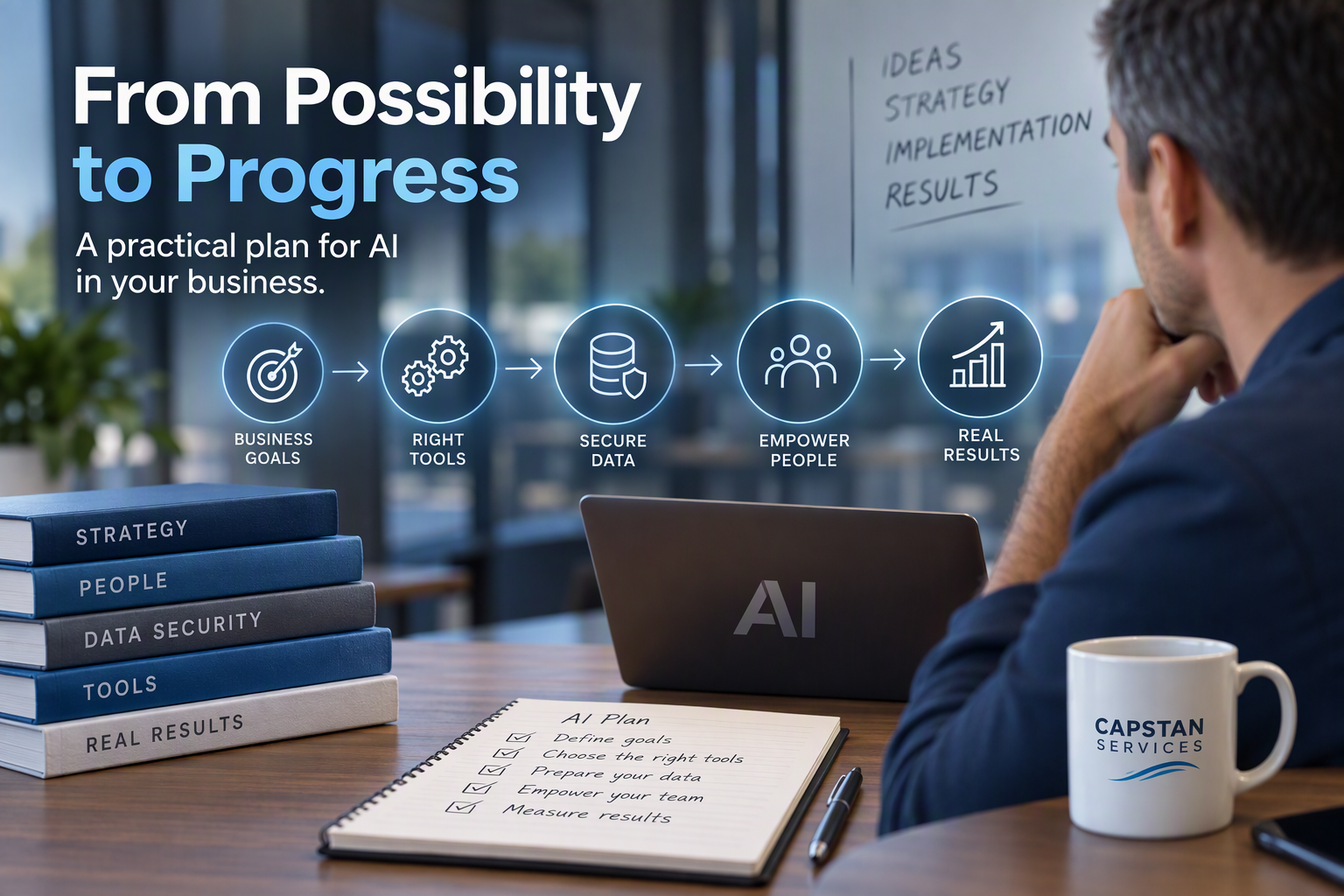
Setting Your Company’s AI Direction: Choosing the Right Tools and Building a Plan
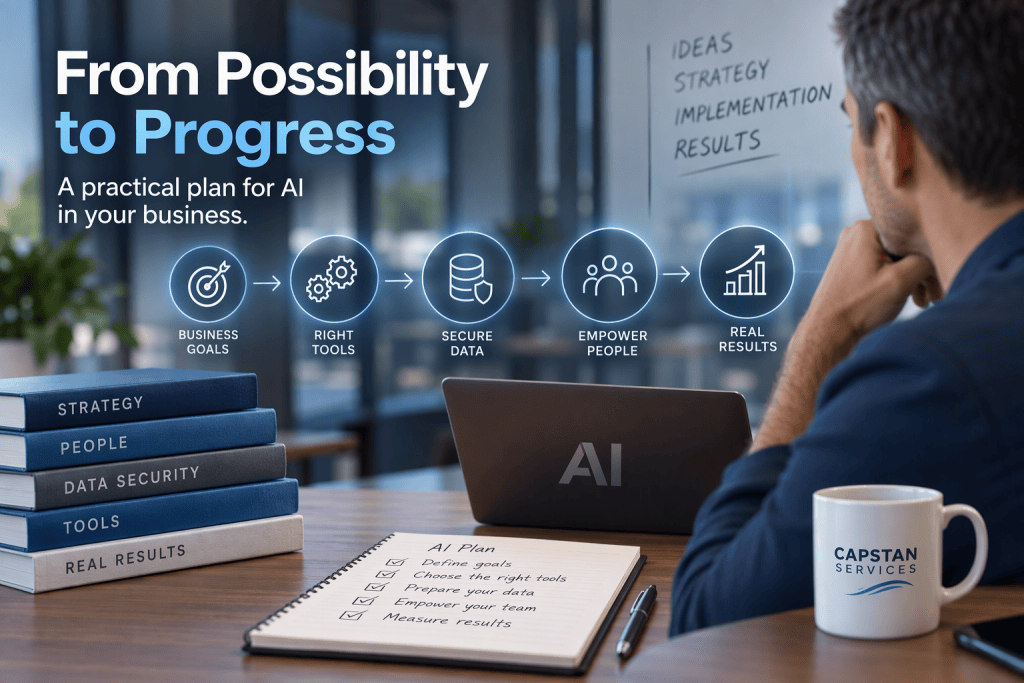
Most businesses don’t deliberately adopt AI. They accumulate it.
One employee buys a ChatGPT subscription. Another starts using Microsoft Copilot. A software vendor adds AI to the CRM. A salesperson signs up for an AI meeting assistant. Before long, the company has multiple AI tools, overlapping subscriptions, sensitive information is being leaked to the public, and the spending is not driving the business forward.
A clear AI direction is in order.
In our previous article, we discussed the importance of an AI policy, which establishes the rules for how AI should and shouldn’t be used. An AI policy is important, but it is not a strategy. You also need a plan for what you want AI to accomplish, which tools belong in your environment, how your data will be protected, and how you’ll measure results.
Start with Business Goals, Not AI Tools
Choosing an AI product first and then searching for problems it can solve is not a strategy. Instead, successful businesses start with an objective that drive business outcomes.
Start by identifying what your current goals are for business growth and productivity. Ask leadership and department managers how they think AI can help achieve these goals. Look for areas like driving sales, processes where the business is losing time, creating unnecessary friction, or performing repetitive work.
Look for opportunities such as:
- Proposals or reports that take too long to prepare
- Important requests buried in overflowing inboxes
- Reports assembled manually from several systems
- Employees repeatedly searching for information
- Meeting notes that must be manually turned into follow-up tasks
Then evaluate each opportunity from three perspectives:
Business: Is the problem worth solving? Could AI save meaningful time, reduce errors, improve service, lower costs, or generate revenue?
Experience: Who benefits? Will employees or customers notice an improvement?
Technology: Is it practical? Do the appropriate tools exist, and are your systems, permissions, and data ready?
The opportunities that score well in all three areas belong at the top of your AI roadmap.
This keeps AI investments focused on business outcomes rather than chasing shiny new tools.
Choose the Right AI Tools for the Job
There isn’t one “best” AI tool for every business. The right choice depends on where your employees work, what information AI needs access to, and what you want it to accomplish.
Most business AI tools fall into a few broad categories:
AI built into your productivity environment. Microsoft 365 Copilot is a good example. Copilot is great when you already have a team working in Microsoft 365.
General-purpose AI assistants. Tools such as ChatGPT and Claude can be valuable for writing, research, analysis, brainstorming, and other general business tasks.
AI built into business applications. Your CRM, accounting system, ERP, WMS, or other software may already include AI capabilities. If the workflow you want to improve already happens there, you may be able to have a quick win without implementing outside AI tools.
Industry-specific AI. Specialized AI tools increasingly support workflows in legal services, healthcare, finance, real estate, and other industries.
Many organizations will ultimately use one primary AI assistant along with specialized AI capabilities in several key applications. This is a good approach so long as each tool has a business purpose.
Evaluate More Than Features
AI demonstrations usually focus on what the tool can do. Businesses also need to understand how the tool brings value to the business.
When comparing AI platforms, consider:
Ecosystem fit: How well does it integrate with the systems employees already use?
Data protection: What happens to your business data? Is it used for model training? Where is information processed or stored, and what retention controls are available?
Administration: Can IT centrally manage users, authentication, access, and connections?
Access to company data: How does the AI obtain information from the organization? What can it access, which permissions control that access, and does the platform create additional copies or indexes of company information?
Security and compliance: Does the platform support the controls your organization requires?
Total cost: Look beyond licensing and include data readiness, implementation, integration, training, administration, and support.
The cheapest subscription isn’t necessarily the least expensive solution if it creates additional costs elsewhere.
Get Your Data Ready Before Connecting AI
This is one of the most important and overlooked parts of an AI rollout.
AI can make company information dramatically easier to find and manipulate. The downside is that without proper data security, categorization and governance, AI can also leak your business data.
Our next installment in this AI series will cover what you need to do to prepare your data for an AI integration. Stay tuned.
Give AI Direction a Clear Owner
Someone needs to own the company’s AI direction.
For a small business, that may be the owner, president, or COO. A larger organization might establish a steering committee combining executive, operations, compliance, and IT leadership.
That group should answer the bigger questions:
- Which AI opportunities should we pursue?
- Which platforms are approved?
- What information can they access?
- Who receives licenses?
- How will employees be trained?
- How will success be measured?
Without ownership, your AI strategy can easily get out of control with high costs and lacking returns.
Invest in Your People, Not Just Licenses
Buying AI licenses is easy. Getting value from AI is not.
Some employees will immediately experiment with AI. Others won’t know where to begin. Some will distrust it, while others may trust its answers too readily.
For sales, that might mean identifying potential clients, automating sales process and preparing for customer meetings. Operations might use AI to improve efficiency or prepare recurring reports. Managers might use it to analyze business performance.
Employees using AI also need to understand where human judgment is needed to validate AI output. Part of the strategy should be to ensure that employees are trained on how to be the oversight on your AI initiatives.
Build a Realistic AI Budget
AI licensing adds up quickly when multiplied across an organization. That doesn’t mean everyone needs top dollar AI license on day one. Start with licensing employees and departments connected to your highest-priority use cases. You can then expand to more people when you prove that the AI is providing value.
Your budget should be more than licenses. Consider:
- Data and permission cleanup
- Implementation and integration
- Employee training
- Security and compliance
- Ongoing administration and support
Not sure where to start? Begin with an inventory of what you’re already paying for. Look for overlapping AI subscriptions or AI capabilities already included in software you own.
Pilot, Measure, Then Expand
Don’t make your first AI initiative a company-wide rollout. Start with one or two clearly defined business problems and a pilot group of users.
1. Pilot: Define what success looks like before you begin. It might be increased revenue, faster proposal turnaround, fewer manual steps, or better customer response times.
2. Measure: Compare the results with your starting point. Don’t just ask whether employees liked the tool. Ask whether the outcome improved.
3. Expand: When something works, introduce it to more users, incorporate what you learned into training, and adjust your policies or technical controls as necessary.
4. Automate carefully: As your organization becomes more experienced, consider AI agents and automated workflows. Keep in mind that there is an important difference between AI that suggests an action and AI that takes an action. Keep humans in the loop for decisions relating to customers, money, security, or sensitive information.
Direction First. Tools Second.
The companies that gain the most from AI won’t necessarily be the ones with the most AI subscriptions. They’ll be the ones that know why they’re using AI and how it impoves the business. They will identify worthwhile business problems, choose technology that fits their environment, protect their information before connecting it, train their employees, measure the results, and expand where value is identified.
Getting Started
At Capstan Services, we help South Florida businesses get ready for AI the right way: writing practical AI policies, building your strategy, reviewing data permissions before any tool is connected, and configuring AI so it works for your business without exposing what matters most. If you’d like help getting started, contact us to schedule a conversation.