
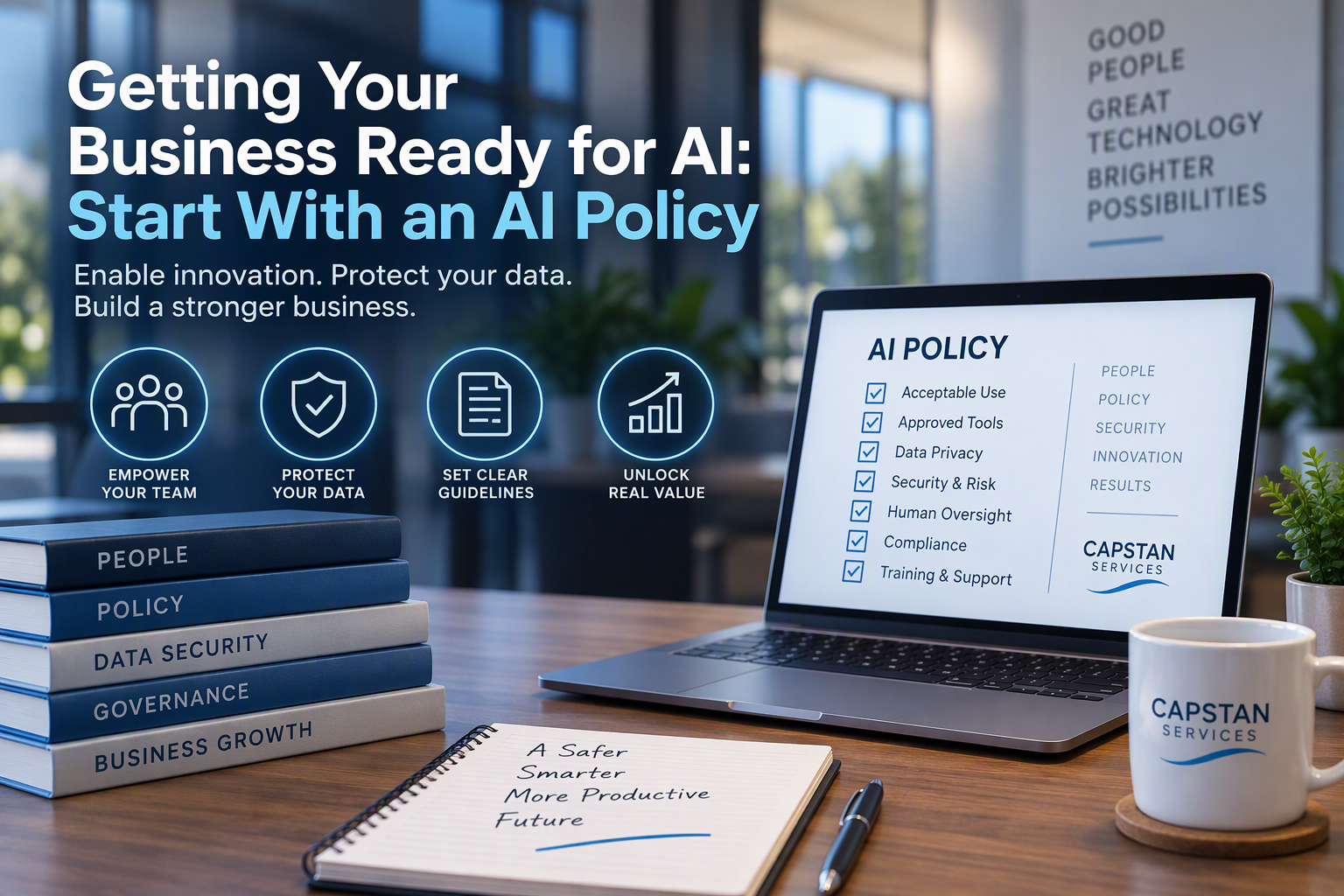
AI isn’t coming to your business. It’s already in your business. Your employees are probably using AI even if the business has not set an AI direction or authorized AI tools. Creating an AI policy is the first step to ensuring that your employees are using AI in a manner that aligns with your business goals and that AI tools are not leaking your business data.
Used well, AI can save hours every week and help individuals and small teams to perform at a level that previously required a large team. The tradeoff is that without guardrails, it can expose confidential information, put errors in front of customers, and create legal risk you never saw coming. This is why a comprehensive AI policy should be the first step in your business’s AI effort.
Your AI policy is where you can set the tone and goals for AI usage in your business. An AI policy gives your team the confidence to use AI productively while also protecting your customers, your data, and your reputation. Here are ten areas your business should consider when building an AI policy.
1. Acceptable and Prohibited Uses
Start by telling people what they can do. You don’t want to make employees afraid to use AI, but you also want to put limits in place. Encourage employees to use AI tools in a manner that is in line with your business goals and which will help improve their productivity.
Creating acceptable uses is the right time for executive management to align AI with the business. AI costs are rising, so this is an opportunity to look at where the cost of AI tools makes sense for your business. AI should make both business and financial sense.
Your AI policy should also call out what is off limits: illegal activity, deception, harassment, impersonating real people, creating misleading content, and getting around company controls. The risks with AI are real, and spelling out what is prohibited is key to keeping control.
2. Approved and Prohibited Tools
One of the biggest risks today is “shadow AI,” which means employees using personal or free AI accounts for company work. Free tools generally use all data shared with them to train their models, keep your data indefinitely, or lack the security controls your business needs. Most businesses prohibit the use of free and personal AI tools.
Your policy should list the AI tools the company has reviewed and approved for use. It is best practice to require that company work happen only in company accounts tied to your organization’s sign-in and security policy. Name any tools or categories that are specifically prohibited and explain why. When people understand the reasoning, they’re far more likely to follow the rules.
3. Connecting AI to Company Systems
Using an AI assistant to draft an email is one thing. Connecting AI directly to your CRM, financial system, file storage, or customer database is something entirely different. Once connected, an AI tool may be able to read, change, or share large amounts of sensitive information, sometimes without human oversight.
For this reason, any integration between AI and company systems should require executive sign-off and be implemented by IT staff. Employees should never connect an AI tool, plug-in, browser extension, or automation to company systems on their own. When IT configures access, it can be configured with the minimum permissions needed, properly documented, and monitored over time.
4. Request and Approval Process
Your employees will find new tools that they think can help them to perform their job more effectively. You want to encourage innovation without allowing risk to the business.
Your policy should explain how to request a new AI tool or use case: who to contact, what information to provide (the tool, its purpose, and the data involved), and what the approval path looks like. Define who approves what. A low-risk use might need only a manager and IT review, while anything touching sensitive data or company systems goes to executive leadership for approval.
5. Data Privacy and Confidentiality
If your policy does only one thing well, it should be this. Every employee needs to know what information can and cannot go into an AI tool.
The simplest approach is to tie AI use to data classification levels:
- Public: Information already published, such as marketing materials. This can be used with any approved tool.
- Internal: Everyday business information. This can be used only with company-approved tools.
- Confidential: Customer data, financials, contracts, and employee records. This can be used only in approved tools specifically cleared for confidential data, if at all.
- Restricted: Passwords, credentials, trade secrets, and regulated data. This should never be allowed into an AI tool.
If you do not have data properly classified in your business systems, it is critical to get a data categorization project completed before connecting AI to your data. Your AI policy should also address your legal obligations. Privacy laws, industry regulations, and customer contracts may limit how data can be processed with AI.
6. Human Oversight and Accountability
AI is a powerful assistant, but it should never have the final say. The guiding principle should be that AI assists with human oversight. AI tools can “hallucinate” and produce confident, polished answers that are completely wrong. Your policy should require a human review of AI-generated work before it’s used, published, or sent. Facts, figures, quotes, citations, legal language, and code all need to be checked before they are used, and your AI policy should ensure that processes for human oversight are in place.
7. Intellectual Property and Copyright
AI raises new questions about who owns what. Your policy should state that work created with AI assistance for the company belongs to the company, just like any other work product.
Your AI policy should protect your company’s intellectual property by keeping proprietary material out of tools that might use it for training. You should prohibit uploading copyrighted material or third-party content in ways that break its license terms, and check AI output for copied text, images, or code before publishing. Remind employees that the legal landscape is moving quickly, so when in doubt, they should ask before using AI-generated content in anything you plan to sell, trademark, or publish.
8. Security and Incident Reporting
AI brings new security threats that businesses need to address. Your policy should require strong authentication on all AI accounts, train employees to verify unusual requests even when they look or sound legitimate, and vet AI vendors on how they store, protect, and use your data.
You should also make it easy to report problems and security concerns. Whether it’s sensitive data entered into the wrong tool, a harmful output, or a suspected scam, employees should know exactly who to tell and how fast. Quick reporting can turn a potential crisis into a manageable fix.
9. HR Considerations: Bias, Fairness, and Ethics
AI learns from huge amounts of data, and that data can reflect real-world biases. When AI touches decisions about people, those biases can turn into unfair treatment and legal exposure.
Your policy should require extra care whenever AI is used in hiring, performance management, promotions, compensation, or discipline. AI should never make these decisions alone. A qualified person should review any AI input, and the process should be checked regularly for concerning outcomes. Be careful about using AI to monitor employees and be transparent when you do it. Consider connecting your AI policy to your company’s values and code of conduct. The ethical standards you expect from people should apply equally to the tools they use.
10. Enforcement and Consequences
A policy only works if there are consequences. Spell out what happens when your policy is violated and connect those consequences to your existing disciplinary procedures.
Pair enforcement with support. Require every employee to read and acknowledge the policy, provide regular training, and review the policy on a specified basis. AI and the laws that govern it are changing quickly. The goal is a culture where people use AI confidently and responsibly, not one where they’re afraid to use it.
Getting Started
An AI policy won’t make your business AI-ready on its own, but nothing else works without one. Your policy should set expectations, protect your data, and give your team the confidence to use AI productively.
At Capstan Services, we help South Florida businesses get ready for AI the right way: writing practical AI policies, reviewing data permissions before any tool is connected, and configuring AI so it works for your business without exposing what matters most. If you’d like help getting started, contact us to schedule a conversation.